New week, new failures: Nine contributions from week 27.10-2.11 (KW44-2025). Highlights from hundreds of articles, two Posts of this are salted with all sorts of opinions, as a Sunday review across the ‘wews of the week’.
EU CSNF | Nano pixels | Fab1 Dresden | Health data | Azure down | Digital euro | NVIDIA 5B | Chat control Ade! | Atari Halloween Edition
Article 1
Digital control system: EU assesses cloud sovereignty
While chat control is being slowed down, the EU is working on a new framework to strengthen its independence from US tech companies: the Cloud Sovereignty Framework (CSNF).
This framework is intended to help the EU and its member states to ensure that cloud services are not only secure, but also secure. Digital Sovereignty to evaluate. Simply put: It will be an System of censorship established to see how ‘European’ a cloud service really is and how strongly it is under foreign influence.
The framework defines eight key areas (sovereignty objectives), which include in the evaluation:
- Strategic sovereignty (15)%): Where is the provider anchored (property, financing, governance)?
- Supply chain sovereignty (20%): The highest weighting is in control of hardware, software origin and critical components to reduce dependencies.
- Operational sovereignty (15)%): How independently can the service be operated and developed by EU actors (e.g. simple migration, EU staff)?
- Legal & Data Sovereignty (10 each)%): Protection against foreign laws (such as the US CLOUD Act) and customer control over their data (including encryption and AI models).
The result is an Sovereignty Effectiveness Assurance Level (SEAL), which serves as a minimum requirement, and a Sovereignty score, which as Award criterion It is used in public tenders.
Read more about it: The editorial team of Heise has summarized the details of the CSNF.
Article 2
The smallest pixel in the world shines in Würzburg!
Hey technology and future fans, if you thought our mobile phone displays already had a crass resolution, then hold on! This week there was groundbreaking news directly from Lower Franconia, more precisely from the Julius Maximilian University of Würzburg (JMU). There, the physicists around Professor Bert Hecht succeeded in doing something absolutely crazy: You have the world's smallest individually controllable OLED pixel Developed!
The Tiny One from the Nano World
How small is "the smallest"? The pixel is just 300 x 300 nanometers It's big.
- For classification: A nanometer is the millionth part of a millimeter.
- The comparison: This is smaller than the wavelength of visible light!
- The record: Currently, we have commercial display pixels that are about 5 x 5 microns in size. The Würzburg researchers have shrunk their light-emitting diodes to a tiny area of 0.3 x 0.3 micrometers.
What's behind the mini-revolution?
The researchers used two clever ideas: You are using Optical antennas made of metal, which amplify and emit the light, and have the gold electrodes of the pixel with an additional Insulating layer covered. This cover prevents interference fields at the edges and lets the light out only in a tiny, only about 200 nanometers small, round hole in the middle.
The result is not only tiny, but also Just as bright like a conventional OLED pixel and at the same time extremely Responsive.
What does that bring us? The Future in Glasses!
This nano-pixel is much more than just a scientific record. It is the key to truly compact and high-resolution future technologies:
- VR/AR glasses: Imagine that a display with Full HD resolution (1920 x 1080 pixels) would only have an area of a square millimeter fit! Such mini projectors could be integrated directly into the temples of glasses and project the image onto the lens.
- Energy efficiency: Because OLEDs are self-luminous and do not require backlighting, they are energy efficient, perfect for portable augmented and virtual reality (AR/VR) applications.
The work of Würzburg physicists, published in the journal Science advances As a result, the door for displays in contact lenses, mini-projectors and extremely high-resolution microscopy is wide open.
A small step for a pixel, but a huge leap for display technology!
What do you think of this nano-revolution? Do you see us all running around with these high-tech data glasses soon? Write in the comments!
Source: JMU Würzburg | Science advances
Article 3
Billion-dollar investment in Saxony's future: Globalfoundries launches Fab1 expansion in Dresden
Mega news from the German ‘Silicon Saxony’: The US chip manufacturer Globalfoundries (GF) has officially launched a massive expansion of its Factory 1 (Fab1) given in Dresden.
With one Investment of 1.1 billion euros (according to other sources 1.2 billion euros) GF reaffirms its deep commitment to the site and positions Dresden as an even more important pillar of European chip sovereignty.
What is being built in Dresden?
The expansion project, internally as ‘SPRINT’ It aims to significantly increase production capacity and strengthen critical supply chains:
- Capacity increase: The capacity is expected to increase from currently around 950,000 wafers per year to More than 1.1 million wafers increase annually. This is to be implemented by the end of 2028 and makes the Dresden location Largest of its kind in Europe.
- Technology focus: The expansion primarily enables the production of chips on 300 mm wafers and the deepening of manufacturing for high-performance markets. A special focus is on the production of circuits for:
- automotive (specifically radar systems and 32-bit MCUs)
- Aerospace
- Defence sector and Critical infrastructures
The increase in capacity is mainly due to a Extended cleanroom (an area increase of about 5000m2) as well as realized by new, more productive production plants.
A clear commitment to Europe
The billion-dollar investment, which is also expected to come from the European Chips Act Federal Chancellor Friedrich Merz and Saxony's Prime Minister Michael Kretschmer were prominently welcomed.
Chancellor Merz called the SPRINT project “Commitment to Germany as a location for industry and innovation and, above all, to the sovereignty of our country and Europe.”
The expansion of Globalfoundries is an important signal in global chip competition and is instrumental in reducing Europe's dependence on Asian and American manufacturing and building more resilient European supply chains.
In short: Dresden is massively expanding its status as Europe's chip capital and is becoming an even more important hub for the production of key chips that we need for our cars, communications and critical infrastructure.
Article 4
Your health data is already being used Do you know that?
The Research Data Center for Health (FDZ) has been officially launched since October and has already stored all billing data of the statutory health insurance funds from 2009 to 2023. That's 75 million insured, 600 million cases, 8 billion records. Researchers from science and industry can now apply for access.
Monday is a detailed article online, here only the TL:DR version:
The most important facts:
Constanze Kurz of the CCC warns: The majority are unaware of the disclosure of their health data.
No possibility of objection: There was no opt-out for the 2009-2023 billing data
The pharmaceutical industry has access to: Economic interests meet highly sensitive data
Two-class system: Privately insured persons and the Bundeswehr are excluded
European Health Data Space: Your data will be accessible throughout the EU in the future
ePA becomes mandatory: The electronic health record is to be rolled out ‘sanctioned’ by 2025
The problem:
The data are only pseudonymised before – no real anonymisation. The GFF has already filed a lawsuit. The CCC warns against a "creeping reduction of health data protection for the benefit of economic interests".
Medical research is important – but not without real information, not without real choice, and not at the expense of fundamental rights.
What you can do:
Inform yourself on the Website of the FDZ Health. Oppose your health insurance company's use of your ePA data for research. And as always: Stay vigilant and demand transparency!
Article 5
Cloud chaos at Microsoft, Azure down for hours!
Hardly a week after Large AWS outage, met it on 29 October 2025 The next cloud giant: Microsoft Azure and many related services were severely disrupted.
The most important in brief:
- Services concerned: Worldwide, central Microsoft services such as Exchange Online, the whole Microsoft 365 Suite (Word, Excel, etc.) Microsoft Entra (Authentication) and many more about 8 hours Limited or not usable at all.
- The cause: Microsoft has identified an ‘unintended configuration change’ at the Azure front door infrastructure. Azure Front Door is the global content delivery network (CDN) and the central ‘entry door’ for almost all Microsoft cloud services.
- The Curse of DNA: The faulty configuration led to massive DNS problems (the telephone book of the Internet), which prevented the services from being found or addressed correctly.
- Consequences: Airlines such as Alaska Airlines and Hawaiian Airlines reported disrupted check-ins, major retail chains such as Starbucks had problems with mobile payment, and gaming services such as Xbox Live fell out.
The incident underscores once again the The extreme fragility of our digital infrastructure and the need for Multi-cloud strategies and robust contingency plans.
All the details about the outage, the exact timeline and the lessons learned from the cloud chaos in October You can find it in the detailed blog post.
Article 6
ECB: Green light for the next phase of the digital euro. Ready for release in 2029
The European Central Bank (ECB) on 30 October 2025, officially decided to move to the next phase of the digital euro project: the preparatory.
The key points:
- Objective: The digital euro is intended to complement euro cash and transfer its benefits (privacy, simplicity, availability) to the digital world in order to Monetary sovereignty and economic security to preserve.
- Timetable: The Eurosystem as a whole shall: from 2029 be ready for a potential first edition of the digital euro. The prerequisite for this is that the EU co-legislators adopt the necessary regulation for the introduction of the digital euro in 2026. Initial pilot projects could start in mid-2027.
- Costs: The external development costs up to the potential first edition will be approximately EUR 265 million the value that the Eurosystem would bear.
- ECB President Christine Lagarde stressed: “We are working to make its most tangible form (euro cash) fit for the future by redesigning and modernising our banknotes and preparing for the issuance of digital cash.”
The ECB underlines that the final decision on an issue will only be taken after the adoption of the relevant EU legislation. The preparation phase serves to develop the technical foundations and to finalize the set of rules.
Article 7
Historical stock market record: Nvidia is the first company to be worth $5 trillion
It is still Not so long ago, I wrote in the Wews., That NVIDIA has very briefly replaced the all-time leader Apple as the most valuable company on the stock market, with a market value just under $4 trillion.
The chip company Nvidia Just a quarter later, on 30 October 2025, the world's first company has now acquired the historic brand of $5 trillion Exceeded the stock market value.
The most important facts:
- High-altitude flight through AI: The massive price jump – the share temporarily rose by five percent in early US trading – is on Nvidia’s Key role in the current boom in artificial intelligence (AI) Returned.
- Dominant market position: Nvidia's chip systems are the world's preferred tool for training large AI applications. Customers include technology giants such as Google and Meta, as well as leading AI startups such as OpenAI.
- Explosive growth: This central market position has made Nvidia's business grow explosively over the past two years. Investors are counting on the company to successfully defend its technology leadership, especially in the latest chip generations such as Blackwell.
- Geopolitical role: The company is also maneuvering in the tense relationship between the US and China. Despite U.S. export restrictions preventing the sale of the most powerful chips to China, CEO Jensen Huang is seeking dialogue with the U.S. government to prevent the emergence of a strong Chinese competitor.
- Distance to the competition: With a value of $5.05 trillion at times, Nvidia is consolidating its position as the most valuable company in the world with a clear gap to Microsoft and Apple, whose stock market values currently stand at around $4 trillion.
Article 8
Victory for privacy and new EU control
This week there was light and shadow in the EU's network policy. The most important in brief:
Happy Halloween: The eventless chat control is stopped for the first time!
Good news for all those who have sounded the alarm in recent months: In its latest draft of the CSA (Child Protection) Regulation, the EU Incidentless mass surveillance Give up your private chats. This is the so-called Client side scanning – the automatic screening of your encrypted messages before they are sent – off the table for the time being!
This is a huge success for digital privacy and end-to-end encryption, to which Your protest It has made a significant contribution. You will find the detailed contribution to this here on our blog.
- The hook: Targeted monitoring measures are still possible. So we remain vigilant so that the door to mass surveillance is not reopened through the back door.
Article 9
Halloween news: Atari 2600+ returns in PAC-MAN look
Just in time for Halloween 2025, the retro gaming classic Atari 2600+ celebrates its return in a bright yellow PAC-MAN Special Edition.
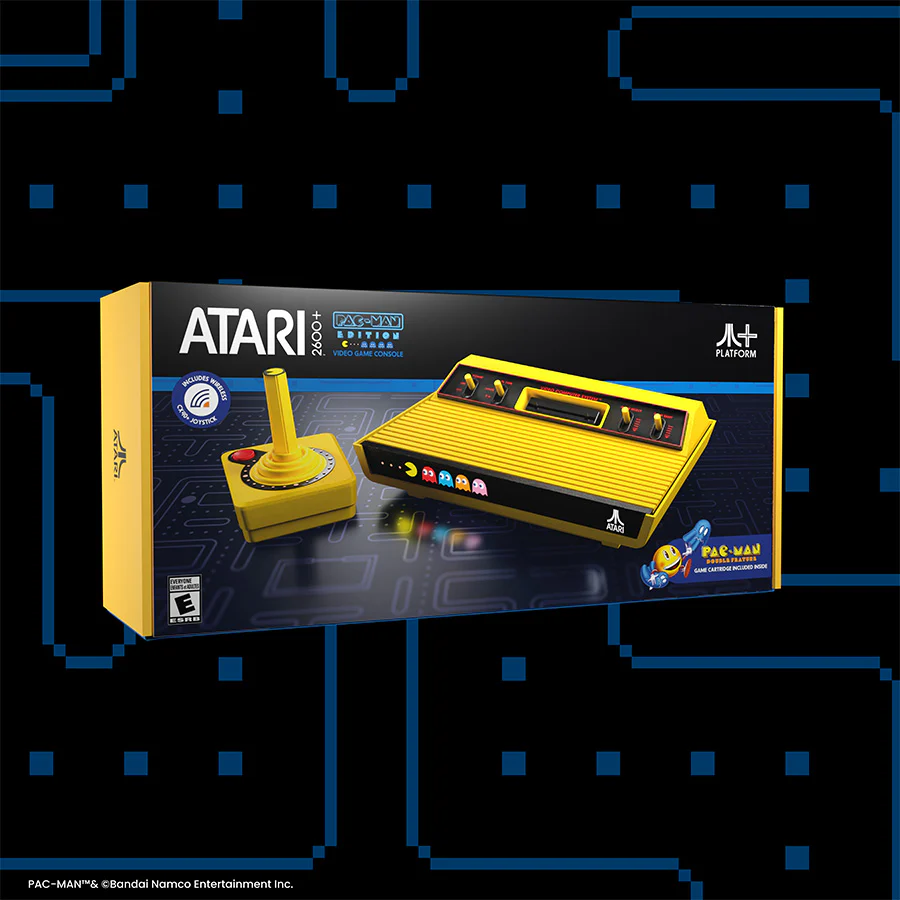
I had the Preoder already announced in the Wews at the end of July, If you had placed your Preoder there, you should already have it. Everyone else can strike now, too. ⁇
Highlights of the special edition:
- Design: The console shines in the iconic yellow of PAC-MAN and features illuminated PAC-MAN symbols on the front for the perfect nostalgic look.
- Games: In the scope of delivery is the PAC-MAN Double Feature Cartridge the original classic (PAC-MAN 2600) as well as the improved PAC-MAN 7800 Arcade version is available.
- Controller: The console comes with a wireless CX-40 controller in matching yellow. For collectors, additional wireless controllers are separately available in the colors of the four ghosts (Blinky, Pinky, Inky, Clyde) is available.
- Availability: The PAC-MAN Special Edition has been available since its official release. 31 October 2025 available.
This lovingly designed edition pays homage to the first home console version of PAC-MAN and combines collectible value with gaming fun.
It's a classic conclusion again today. Since our colleague Sun-Tsu is back from his training, he has one of his wisdoms ready again this week:
“Where one intends to fight must not be known. Distribute your defense so that the enemy has to fragment his forces.’
Turn the principle of Zero trust architecture (Micro-segmentation, strict access control) to prevent a breakthrough in one place from leading to the immediate loss of control of the entire environment.
 EN
EN  DE
DE  ES
ES  FR
FR  IT
IT